
Linear Gate Repair in Davie: A Homeowner’s Guide
Most Linear operators that get replaced in Davie didn’t need to be. The OSCO and AE series share a known weak point: the transformer connection corrodes at the terminal strip before anything else fails, and the symptom – a dead operator with no lights, no response – looks exactly like a blown control board. Homeowners and even some technicians jump straight to replacement. Here’s how to tell the difference, and what’s actually worth fixing.
If you’d rather not climb around a gate operator yourself, call (877) 802-1841 for a free estimate. We work on the gate you have.
Why Linear Operators Fail Differently in Davie
Linear built its reputation on operators that just keep running. That’s the problem. A workhorse that never complains gets ignored, so the small warning signs – a remote that needs two presses, a gate that hesitates for half a second – go unnoticed for months. By the time the gate stops, a minor fault has usually grown into something that looks terminal.
Davie’s humidity does the rest. Warm, damp air sits inside the operator housing and works on the low-voltage terminal strip, especially where the transformer leads land. The connection corrodes, resistance climbs, and the operator behaves like it’s lost its board. We’ve seen this pattern repeat across Davie communities with older Linear installations, and it’s the single most misdiagnosed fault on the brand.
What separates Linear from something like a LiftMaster or FAAC in this climate is where the vulnerability sits. Linear’s terminal strip and transformer placement puts the connection in the path of moisture in a way that other designs avoid. That’s not a knock on the brand – it’s the reason the fault has a signature, and a signature means it can be confirmed rather than guessed.
If your gate is doing something that doesn’t match the transformer symptom, it may not be a Linear-specific issue at all, and gate repair starts with figuring out which fault you actually have.
How to Identify Your Linear Model
Before anyone diagnoses anything, you need to know which operator you own. Linear’s residential and light-commercial line spans several variants, and the parts don’t always swap between them. Reading the label takes five minutes and saves a wrong-order delay later.
- Find the operator housing – the metal box usually mounted near the gate, not on it.
- Look for the manufacturer label, typically on the inside of the access cover or the side panel.
- Read the model and serial line. Linear’s AE and OSCO designations are what you’re after, plus any suffix letters.
- Note whether the label reads Linear or Viking. Viking-branded units came out of the same lineage, and the parts crossover matters.
- Photograph the label and the control board before you close anything up. It’s the fastest way to get an accurate answer on parts.
If the label is faded or gone, the board layout itself usually gives it away. Send us a photo and we can usually tell you what you’re looking at.
The Transformer Terminal Corrosion Issue, and How to Confirm It
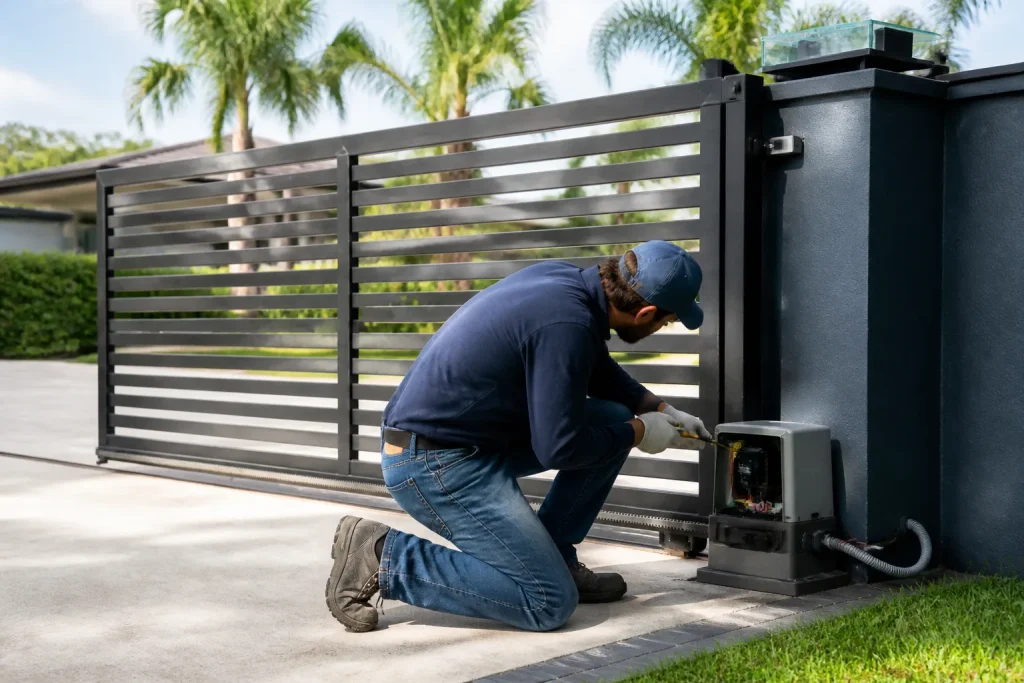
Here’s the test that separates a corroded transformer connection from a dead board. It’s the first thing we check on any Linear unit that’s gone completely silent.
- Look at the terminal strip. With power off, inspect where the transformer leads land. Green or white crust, dark pitting, or a loose screw on those terminals points to corrosion.
- Check for board life. A truly failed board usually shows no indicator activity at all. A corroded feed can leave the board healthy but unpowered, which looks identical from the outside.
- Test the low-voltage side. A technician measures voltage at the transformer output and at the board input. A gap between the two confirms the connection is the fault, not the board.
- Clean and retorque, then retest. If the operator comes back to life after the terminals are cleaned and reseated, you’ve found it. No board replacement needed.
This is where a lot of money gets spent unnecessarily. A board swap on a unit with a corroded terminal strip fixes nothing, and the new board fails the same way within months. Confirming the fault first is the whole game.
We’d also flag the safety side here: gate operators run on line voltage, and the capacitor and transformer hold a charge after the breaker is off. This isn’t a job for a screwdriver and a YouTube video. A trained technician should be the one opening that housing.
DIP Switch Settings and Intermittent Operation
Intermittent problems on Linear operators are often blamed on a failing unit when the real cause is a single DIP switch in the wrong position. Linear’s control logic is set by physical switches on the board, and one wrong setting produces behavior that looks exactly like component failure – a gate that reverses randomly, stops partway, or ignores a remote.
Common culprits:
- A switch set for the wrong operator type or stroke, so travel limits never hold.
- Reversal or obstruction settings configured for a gate weight or length the unit isn’t running.
- A switch nudged during a previous repair, battery change, or a firm closing of the housing.
- Settings that were correct for the original install but never updated when the gate hardware changed.
In our experience, a good share of “failing” Linear operators in Davie are running on a switch setting that’s been wrong since day one or got changed along the way. Checking the switch bank against the manual for your exact model takes minutes and costs nothing. If the intermittent behavior survives a correct switch configuration, then you’re looking at a real component fault.
Parts Availability: What’s Still Stocked and What Isn’t
This is the part of Linear ownership nobody warns you about. Some components are readily available. Others have gone to aftermarket alternatives, and knowing which is which keeps you from waiting on a part that isn’t coming.
Generally still obtainable: control boards for current models, transformers, terminal blocks, remotes and receivers, and common hardware. Generally harder to source: discontinued board revisions, older model-specific components, and anything tied to a variant that’s been out of production for a while.
When an original part is gone, aftermarket equivalents usually exist and work fine – but they need to be matched to your exact model and control logic, not bought by guesswork. That’s where the model identification from earlier pays off. A part that fits an AE variant may not fit an OSCO, and Viking-branded units can differ again.
The honest answer on parts: most Linear repairs are straightforward, and the ones that aren’t usually need a conversation about whether the repair still makes sense. We’ll tell you which side of that line you’re on before any work starts, with the price quoted and agreed up front.
Repair or Replace? The Honest Answer
Age and cycle count decide this, not brand loyalty. A Linear operator with a corroded terminal, a wrong DIP setting, or a failed transformer is worth repairing – those are inexpensive fixes on a unit with plenty of life left. The calculus changes when multiple components are failing at once, the board revision is discontinued, or the operator has run a high cycle count over many years.
Signs replacement is the honest answer:
- Repeated board failures after confirmed good power and clean connections.
- Discontinued internals with no reliable aftermarket match.
- Heavy cycle count on a residential-rated unit doing commercial-level work.
- Gate hardware that’s outgrown the operator’s rated capacity.
If you’re weighing repair against a new install, it’s worth knowing that full installation is part of what we do – from a broken arm to a full installation, one point of contact. No calling a second contractor when the answer turns out to be replacement.
When to Call a Pro
If your Linear operator is dead, intermittent, or behaving strangely, there’s a short list of things worth checking yourself: confirm the model label, look for obvious corrosion at the terminal strip, and check the breaker. Past that, the work involves line voltage, stored charge, and control logic that has to be measured, not guessed.
Same-day service is available, and getting a technician out early usually means a smaller repair. We answer 24/7. Fast dispatch from 7am to 7pm, Sunday through Friday. When the fault is electrical or the operator needs a board-level diagnosis, that’s the work electric gate repair covers, and it’s the specialty we built the business around.
Related services in Davie: gate repair for mechanical and structural issues, electric gate repair for operators, motors, and control systems, and full gate installation when repair stops being the right answer.
The Bottom Line
Linear operators earn their reputation, and that’s exactly why so many get replaced when they just needed a terminal cleaned or a switch corrected. If your gate has gone quiet, confirm the model, check the transformer connection, and verify the DIP settings before anyone talks about a new operator. Those three checks catch most of the failures we see in Davie, and they cost nothing to rule out. When the fault is real and component-level, a repair is usually the better spend – and when it isn’t, you deserve a straight answer on why.
If you’re in Davie and need help, Gate Repair Davie offers free estimates – call (877) 802-1841. Our technicians have up to 11 years of experience across Linear and other major brands, and the price is quoted and agreed before any work starts. Gate Repair Davie.
Frequently Asked Questions
Most Linear repairs land in a modest range set by the specific fault – a terminal cleaning and reseat costs far less than a board replacement, and a transformer swap sits in between. The exact figure depends on your model and what’s actually failed, so we diagnose first and give you a written price. Call (877) 802-1841 for an exact quote – estimates are free.
Check the transformer terminal strip for corrosion. On Linear OSCO and AE units, a corroded low-voltage connection mimics a dead board almost perfectly, because the board is healthy but unpowered. A voltage test at the transformer and at the board input confirms it within minutes. Don’t replace the board until that’s ruled out – call us and we’ll confirm the fault before any parts get ordered.
Same-day service is often possible for repair calls. Call (877) 802-1841 – we answer 24/7, with fast dispatch from 7am to 7pm, Sunday through Friday. A call outside dispatch hours is booked into the next opening, Sunday through Friday, 7am to 7pm.
Most current Linear components are still obtainable, including boards, transformers, and remotes. Older and discontinued variants may need a matched aftermarket alternative. We check your exact model and revision before quoting, so you’re not waiting on a part that no longer exists – and if the honest answer is replacement, we’ll say so before any work starts.
Written by the team at Gate Repair Davie.
Need Gate Repair Help?
Call Gate Repair Davie - licensed & insured, here with fast help in Davie.
(877) 802-1841