
Last updated November 15, 2026
 Wrought iron
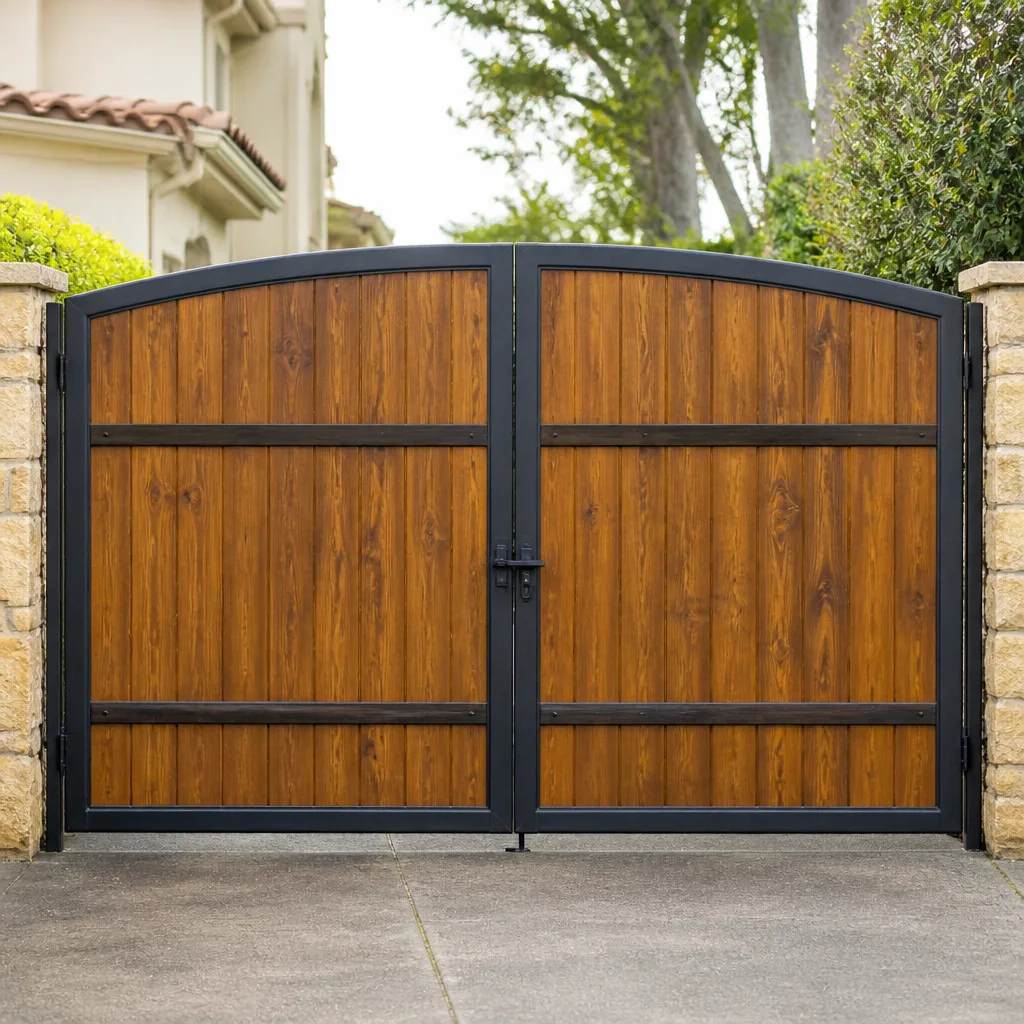 Wood & steel frame
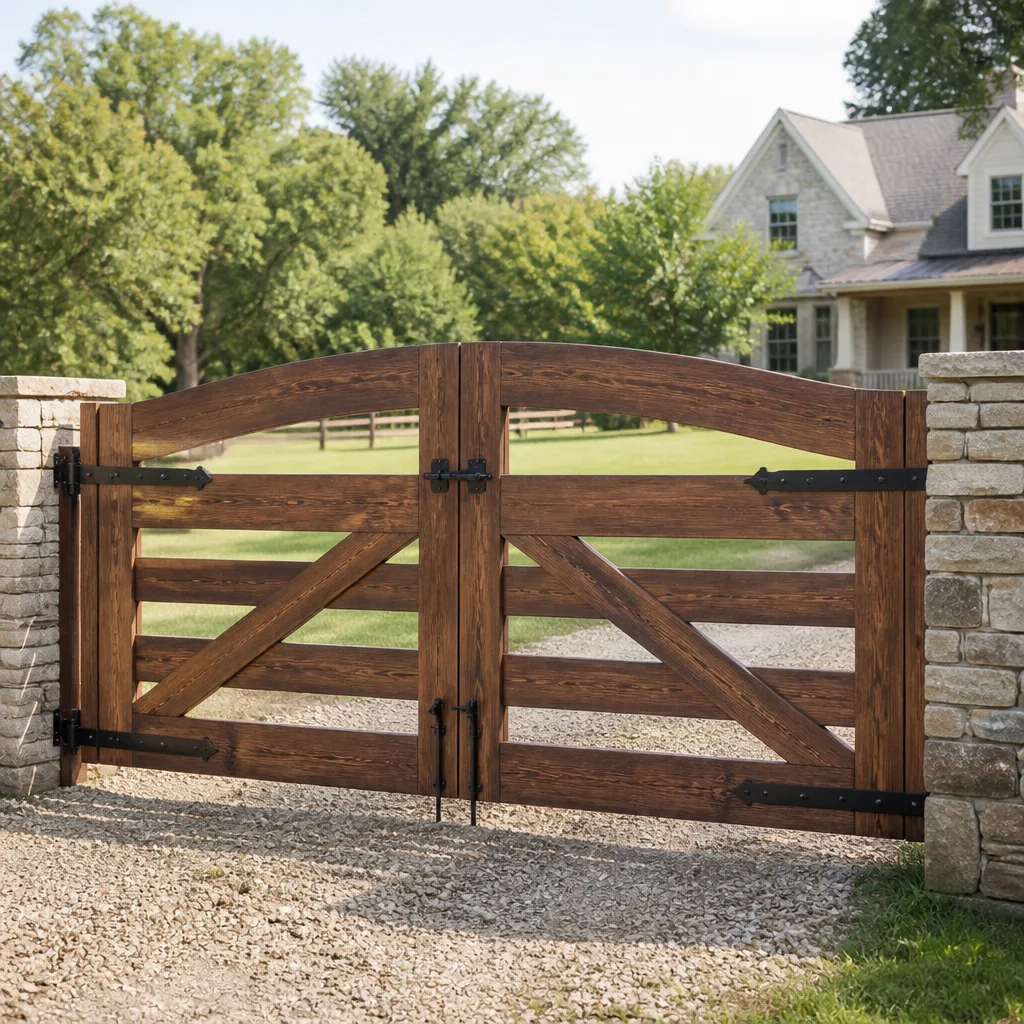 Farm & ranch
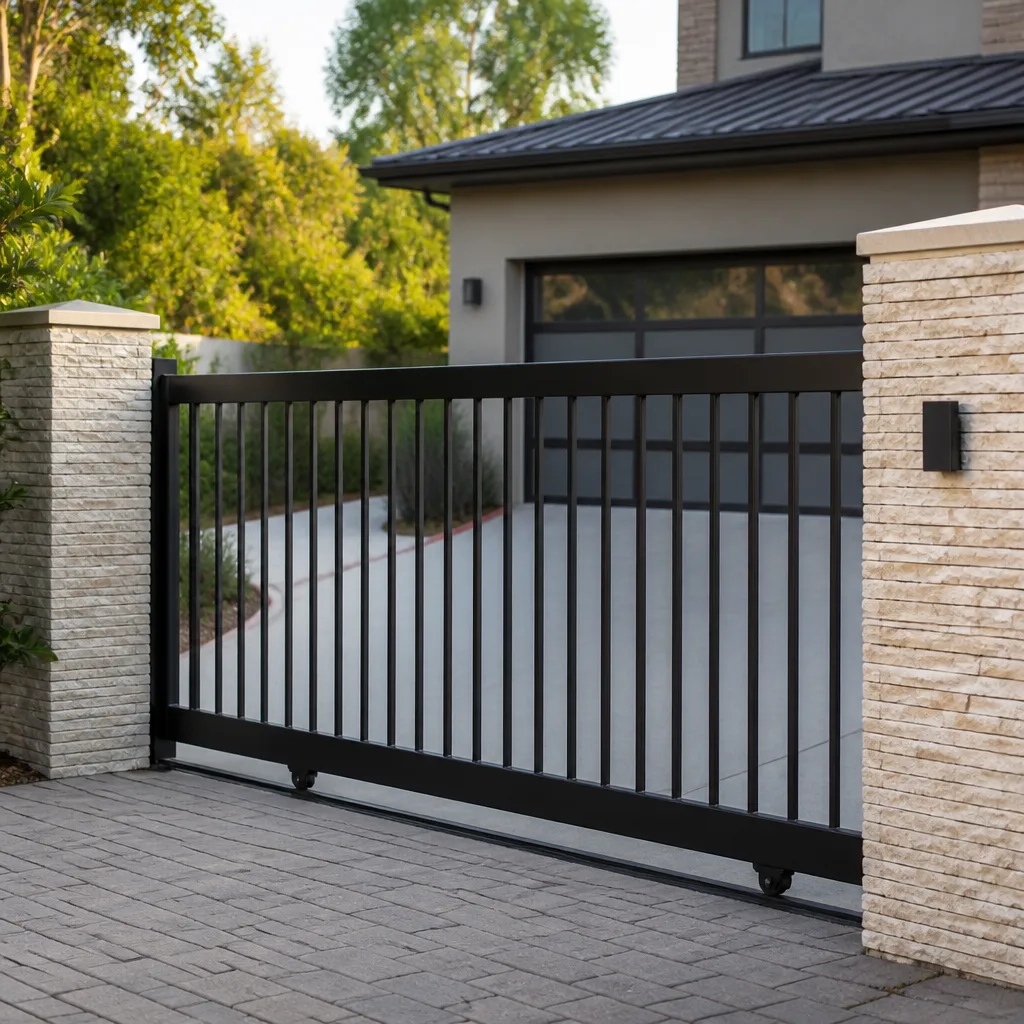 Sliding driveway gates
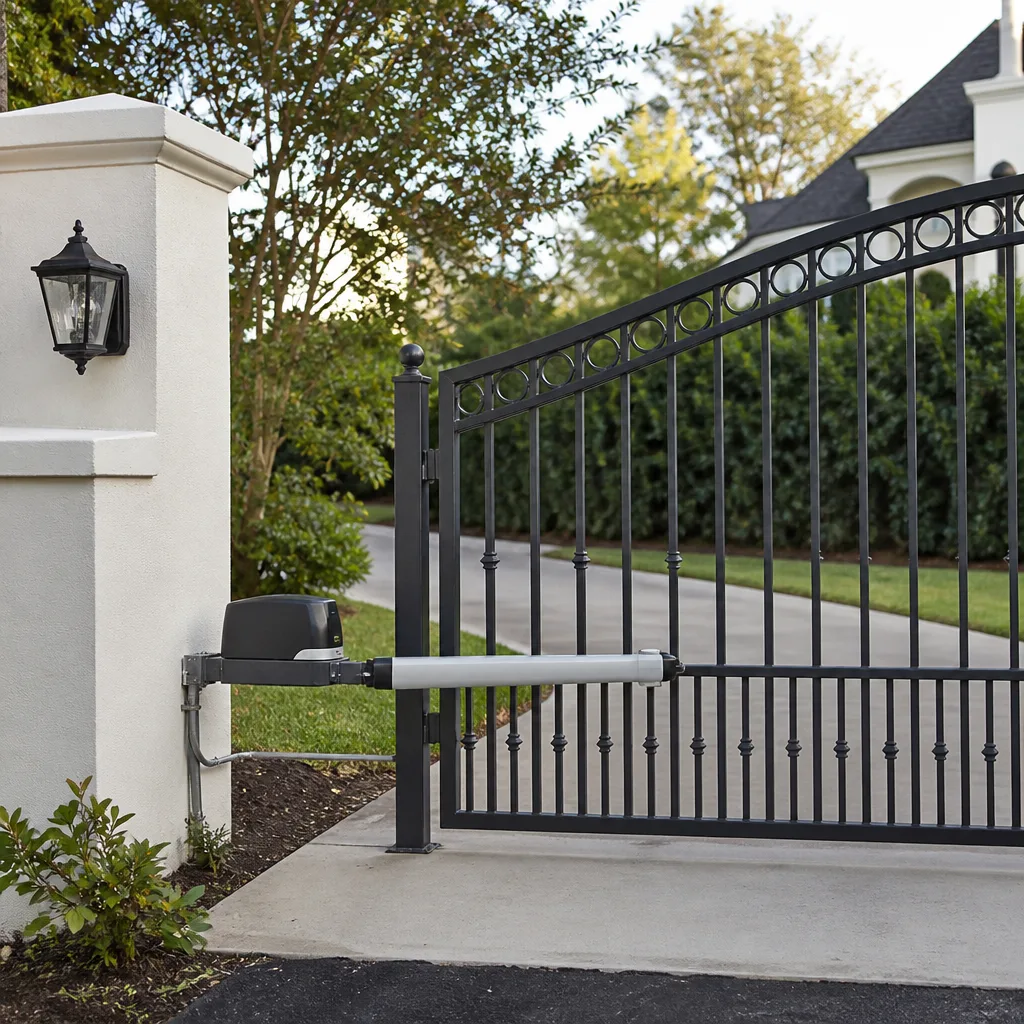 LiftMaster operators
Free on-site gate assessment - hinges, posts, and your LiftMaster or Nice gate operator checked before anything is quoted
The assessment is free and the quote is the invoice.
Get your free estimateGate Repair Troubleshooting in Davie: Common Problems and How to Fix Them
When an automatic gate stops moving, most people assume the motor is dead or the control board is fried. That assumption gets expensive. In our experience across Davie, the majority of “dead gate” calls trace back to something mechanical or a calibration setting, not a failed electronic component. The motor gets blamed, a board gets ordered, and the real culprit – a limit screw that drifted, a track packed with grit, a sensor knocked out of line – sits there unaddressed. This guide teaches you to read a gate’s physical symptoms the way a technician does, so you can tell an operator failure from a sensor fault from plain mechanical obstruction before anyone spends money on parts.
Quick Answer
Most gate problems in Davie come down to three culprits: travel limit screws that are miscalibrated, safety sensors or loop detectors knocked out of alignment by humidity and debris, and mechanical obstruction from track wear, sagging hinges, or swollen wood. Start with the cheapest checks first – limits, sensors, then obstruction – before assuming the motor or control board has failed. A locked-up gate is rarely a dead motor; it’s usually a gate that has been told to stop in the wrong place.
Styles & brands we work with
- Wrought iron
- Wood & steel frame
- Farm & ranch
- Sliding driveway gates
- LiftMaster operators
Table of Contents
- The Force Test: Operator, Sensor, or Obstruction?
- Why Travel Limits Cause More “Dead Gate” Calls Than Motors
- How South Florida Humidity Confuses Loop Detectors
- Brand-Specific Reset Procedures for Davie’s Most Common Operators
- Gate Stops Mid-Travel: Torque Limit or Wiring Short?
- Symptom-to-Cause Matrix: What to Check Before the Technician Arrives
- The Mechanical Checks Everyone Skips
- Repair or Replace? How to Decide
The Force Test: Operator, Sensor, or Obstruction?
The fastest way to sort a gate failure into the right category is a simple force test. Before touching a control board, you want to know whether the gate is physically stuck, whether something is telling the operator to stop, or whether the operator itself has stopped working. These are three different problems with three different fixes, and the test takes about two minutes.
Here’s how the sequence works:
- Disengage the operator. Most residential operators have a manual release – a key, a lever, or a pull cord. Put the gate in manual mode so the motor is no longer holding it.
- Push the gate by hand. A healthy gate should roll or swing through its full travel with even resistance. If it binds, grinds, or stops partway, you have a mechanical obstruction – track, rollers, hinges, or a sagging frame.
- If it moves freely, re-engage the operator and watch the safety sensors. Trigger the gate with the remote. If the operator starts and immediately reverses, the sensors are seeing an obstruction that isn’t there. That’s a sensor or alignment problem, not a motor problem.
- If the gate doesn’t respond at all – no sound, no movement, no safety light activity – you’re looking at an operator or power problem. That could be a tripped breaker, a dead battery in a solar or backup setup, a blown fuse on the board, or a failed operator.
The key insight is that a gate the operator refuses to move and a gate that can’t physically move look identical from the driveway. They aren’t the same problem. Once you know which one you have, the repair path narrows sharply.
Residential gates in Davie range from light Mighty Mule and Ghost Controls swing operators on single-driveway entries to heavier FAAC and DoorKing slide systems on HOA and commercial properties. The force test works the same on all of them. If you’re not comfortable disengaging the operator, or the gate is a heavy commercial slide, stop there and call us for electric gate repair. A gate that rolls under its own weight can be dangerous to test by hand.
Why Travel Limits Cause More “Dead Gate” Calls Than Motors
Travel limit screws tell the operator where the gate is allowed to stop on each end of its run. When they drift – from vibration, temperature swings, or a gate that got bumped hard – the operator thinks the gate has reached its end when it hasn’t. It stops short, refuses to close fully, or runs to the end and then reverses because it registered an over-travel condition. To the homeowner, that looks exactly like a dead gate.
In our experience, roughly six out of ten “dead gate” calls we see in Davie turn out to be miscalibrated limits, not failed motors or blown capacitors. The motor is fine. The board is fine. The gate has simply been told to stop in the wrong place.
How to Check Limits
On most operators, the limit mechanism is a set of cams or screws mounted near the motor housing, with markings that correspond to the open and closed positions. The exact adjustment differs by brand – which is why we keep working knowledge of each one – but the diagnostic logic is the same:
- Open limit drifting: the gate won’t reach full open, or it reaches open and immediately reverses.
- Close limit drifting: the gate stops a few inches short of closed, leaving a gap and breaking the safety loop circuit.
- Both drifting: the gate runs a short distance and stops, or runs to the end and keeps trying to push past it.
If the gate runs its full travel cleanly in manual mode but won’t complete a cycle under power, limits are the first thing to check. We’ve seen homeowners replace control boards when the actual fix was a limit that had drifted a quarter inch. Before you buy any part, check the limits.
Why This Matters in Davie
Davie gates see a lot of cycles. Between residential driveways, HOA entrances, and the commercial properties along the corridors, many operators run dozens of times a day. Every cycle produces a little vibration, and vibration is what drifts a limit screw. That’s why limit checks should be part of a routine gate inspection, not just a once-a-decade event after something fails. If your gate is behaving oddly, gate repair often starts and ends with a limit adjustment.
How South Florida Humidity Confuses Loop Detectors
Loop detectors are the buried wire coils that tell a slide gate a vehicle is present and it’s safe to open or hold. When a loop is healthy, the gate responds crisply to every car. When humidity, standing water, or ground movement disturbs the loop or its splice, the detector gets a weak or inconsistent reading and interprets it as a vehicle that isn’t there. The result: the gate holds open, refuses to close, or cycles on its own.
Davie’s wet season makes this a recurring problem. The soil here holds moisture after heavy rain, and buried loop wire is sensitive to that swing. A loop that works all winter can start behaving erratically in the summer. The instinct is to blame the control board, because loop faults often show up as board faults. Usually it isn’t the board at all.
How to Confirm a Loop Problem Before Replacing the Board
- Watch the detector’s LEDs. Most loop detectors have diagnostic lights that show when a vehicle is detected. If the light is on with no car nearby, the loop is reading phantom traffic.
- Check the splices. Many loop failures trace back to a splice that has taken on water. Look for the handhole or junction point and inspect it for standing water or corrosion.
- Note the timing. If the gate holds open after a rainstorm and returns to normal once the ground dries, the loop is almost certainly the issue.
- Test with a known metal object. A piece of steel moved over the loop should trigger it reliably. If it doesn’t, the loop or detector is faulty.
Replacing a control board because a loop is flooded is spending money on the wrong part. Confirm the loop first. If the loop itself is degraded and the wire runs under pavers or asphalt, that’s a bigger project – and one worth estimating before anyone breaks ground. Call (877) 802-1841 for a free estimate. We answer 24/7. Fast dispatch from 7am to 7pm, Sunday through Friday.
Brand-Specific Reset Procedures for Davie’s Most Common Operators
Many phantom faults – a gate that works on the remote but not the keypad, a gate that cycles oddly once and then acts normal, a gate that stops responding to safety input – clear with a proper power cycle and reset. The catch is that reset procedures differ by brand, and guessing can lock the operator into a wrong state. Here’s the general approach on the brands we see most often in Davie.
LiftMaster
LiftMaster residential operators typically reset by cutting power at the breaker or disconnect for a short period, then restoring power and letting the operator re-learn its limits. If the gate still won’t complete a cycle, the limits need to be re-run. LiftMaster boards also store fault codes that display as LED blink patterns, which is the fastest way to see what the operator is actually complaining about before you touch anything.
Linear
Linear operators use a power cycle plus a limit relearn for most phantom faults. The key with Linear is that the operator must run a full open-and-close cycle under manual supervision after power is restored, or the limits won’t stick. If the gate reverses partway through, stop the cycle and check the safety edge and loops before trying again.
Viking
Viking swing and slide operators have a documented reset sequence that clears the board’s fault memory. In our experience, Viking faults respond well to a clean power cycle and a full test cycle, and the boards generally report their status through diagnostic LEDs. If a Viking gate keeps reporting the same fault after a reset, the fault is real – either a sensor, a limit, or a motor issue – and a second reset won’t help.
We also work on DoorKing, Elite, Ghost Controls, FAAC, BFT, and Mighty Mule, and each has its own reset behavior. The point isn’t memorizing every sequence – the point is that reset before replacement is almost always the right order. A reset costs nothing. A control board doesn’t.
Gate Stops Mid-Travel: Torque Limit or Wiring Short?
A gate that starts a cycle and then stops partway through is one of the trickiest symptoms to read. Two very different causes produce the same behavior: the torque (current) limit is set too tight and the operator shuts down to protect itself, or there’s a wiring short that’s interrupting the signal mid-travel. The fix for one is a calibration adjustment. The fix for the other is a wiring repair. Guessing wrong wastes time and sometimes parts.
How to Tell Them Apart
- Watch the amperage draw. With a clamp meter on the motor lead, the draw during a normal cycle should be steady. A torque limit issue shows a spike right before the stop. A wiring short shows erratic or intermittent readings.
- Note when it stops. Torque limits tend to stop at the same physical point every time, because that’s where the resistance peaks. Wiring shorts stop at random points.
- Check the gate by hand at the stop point. Disengage the operator and push the gate through where it was stopping. If it binds there, the gate itself is the problem and the torque limit is doing its job.
- Inspect the wiring runs. Look for pinched, chewed, or water-damaged wire along the gate and in the conduit. South Florida’s humidity and heavy rain can degrade wiring and produce intermittent shorts.
If the gate stops at the same physical point and rolls freely by hand, adjust the torque limit slightly and retest. If it stops at random points or the meter shows erratic draw, find the wiring issue first. Never increase the torque limit to push past a mechanical bind – you’ll damage the operator and possibly bend the gate. If you’re not comfortable metering the motor lead, that’s a good moment to hand it to a technician.
Symptom-to-Cause Matrix: What to Check Before the Technician Arrives
Homeowners ask us all the time what they can check before we arrive. The honest answer: not much that’s safe to touch on a live operator, but a few observations can cut a service visit nearly in half. The matrix below maps common symptoms to likely causes and to the checks you can safely do yourself. Anything involving opening the operator housing or metering a live circuit belongs to a technician.
- Gate doesn’t move at all, no sound: check the breaker and battery first. If power is on and the gate still doesn’t respond, the operator or board is the likely cause.
- Gate hums but doesn’t move: mechanical bind or a stalled motor. Run the force test in manual mode before anything else.
- Gate moves a few inches and stops: limits, torque limit, or a wiring short. Check limits first, then torque.
- Gate opens but won’t close (or vice versa): safety sensor misalignment, a loop reading phantom traffic, or the safety edge stuck.
- Gate reverses immediately after starting: safety sensor obstruction or a limit that has drifted past the end of travel.
- Remote works, keypad doesn’t (or vice versa): a receiver or access-control issue, not an operator failure.
- Gate cycles on its own: a loop detector reading phantom traffic, often after rain, or a shorted push-button or keypad wire.
- Gate stops at the same physical point every time: mechanical obstruction or torque limit, almost never electronics.
- Operator runs but gate doesn’t engage: a mechanical release left unlocked, a stripped gear, or a broken arm or chain.
Write down what your gate does and doesn’t do before you call. Having “it opens fine but reverses on close, and it started after last week’s rain” is worth a lot more than “it’s broken.” That kind of detail lets us bring the right parts and gives you a faster, cheaper diagnosis.
The Mechanical Checks Everyone Skips
Electronics get all the blame, but the mechanical side of a gate decides whether the electronics can do their job. A gate that binds or sags works the operator harder every cycle, which shortens motor life and causes the exact symptoms people misdiagnose as operator failures. Before you call a board “bad,” run through the mechanical basics.
- Track and rollers (slide gates): grit, leaves, and debris pack into the track. Clean the track and check the rollers for flat spots or wobble.
- Hinges and pivot points (swing gates): hinges wear, especially on heavy wooden gates that swell in the summer. A hinge that binds will stop the gate regardless of what the operator wants.
- Gate sag: a gate that has sagged on its posts no longer aligns with the operator. Check the frame for square and the posts for stability.
- Wood swelling: Davie’s wet season swells wooden gates, and a gate that closed loosely in winter may bind in summer. That’s a seasonal pattern worth noting, not a new operator failure.
- Loose hardware: brackets, bolts, and chain tension. A chain that’s too tight loads the motor; too loose and it jumps the sprocket.
- Obstructions at ground level: vegetation, debris, and settled pavement all interfere with smooth travel.
A gate that’s healthy mechanically makes the electronics much easier to diagnose and much less likely to fail in the first place. When we do a diagnostic, the mechanical check comes first for exactly this reason. It’s also why a gate repair in Davie so often ends up being a mechanical fix rather than an electronics replacement.
Repair or Replace? How to Decide
The honest answer for most gate problems is repair. The operator, the board, the sensors, the loops, and the mechanical hardware are almost all serviceable, and a targeted repair is nearly always cheaper than a new system. Replacement makes sense when the operator itself has reached the end of its life, when parts are no longer available, or when the gate’s physical structure has failed – a bent frame, a cracked post, a badly rusted tail. It’s also worth considering when you’re changing how the gate is used, like moving from a light residential Mighty Mule or Ghost Controls operator to a heavier commercial-grade FAAC or DoorKing system for a busier entrance.
What we try to avoid is the pattern where a board gets replaced because the loop was flooded, or a motor gets replaced because the limits drifted. Those are the expensive mistakes, and they’re made by people who skipped the cheap checks. The right order is: force test, limits, sensors and loops, mechanical, then electronics. A free estimate and a written scope mean you know what you’re paying for before the work begins. If the diagnosis says repair, that’s what we recommend. If it genuinely says replace, we install the new system too, so you’re not calling a second contractor.
If you’re trying to figure out where your gate falls on that line, call us. We work on the gate you have, and we’d rather fix it than sell you a new one.
Common Mistakes to Avoid
- Replacing the control board before checking limits. We’ve seen this dozens of times. A drifted limit screw produces a dead-gate symptom, and a new board won’t fix it because the board was never the problem.
- Increasing torque to push through a bind. Turning up the torque limit to force a binding gate through its cycle loads the motor and can bend the gate frame. Fix the bind, not the torque setting.
- Blaming the loop detector’s board instead of the loop. In Davie’s wet season, a flooded splice looks exactly like a failed board. Confirm the loop before spending on electronics.
- Ignoring mechanical wear because the electronics still work. A binding gate works the operator harder every cycle and shortens its life. Clean the track, check the hinges, tension the chain.
- Leaving a safety sensor alignment out of adjustment. A sensor that’s just slightly out of line is the number one cause of “won’t close” calls, and it’s a cheap fix – but people put it off.
- Buying a “compatible” board on a guess. Different brands and generations take different boards. A board that fits the housing still may not run your operator. Match the board to the operator, not to the price.
- Doing nothing after one phantom cycle. A gate that acts out once and returns to normal is telling you something is marginal – a splice taking on water, a limit about to drift, a hinge starting to bind. Catch it early and it’s a small job.
See the difference
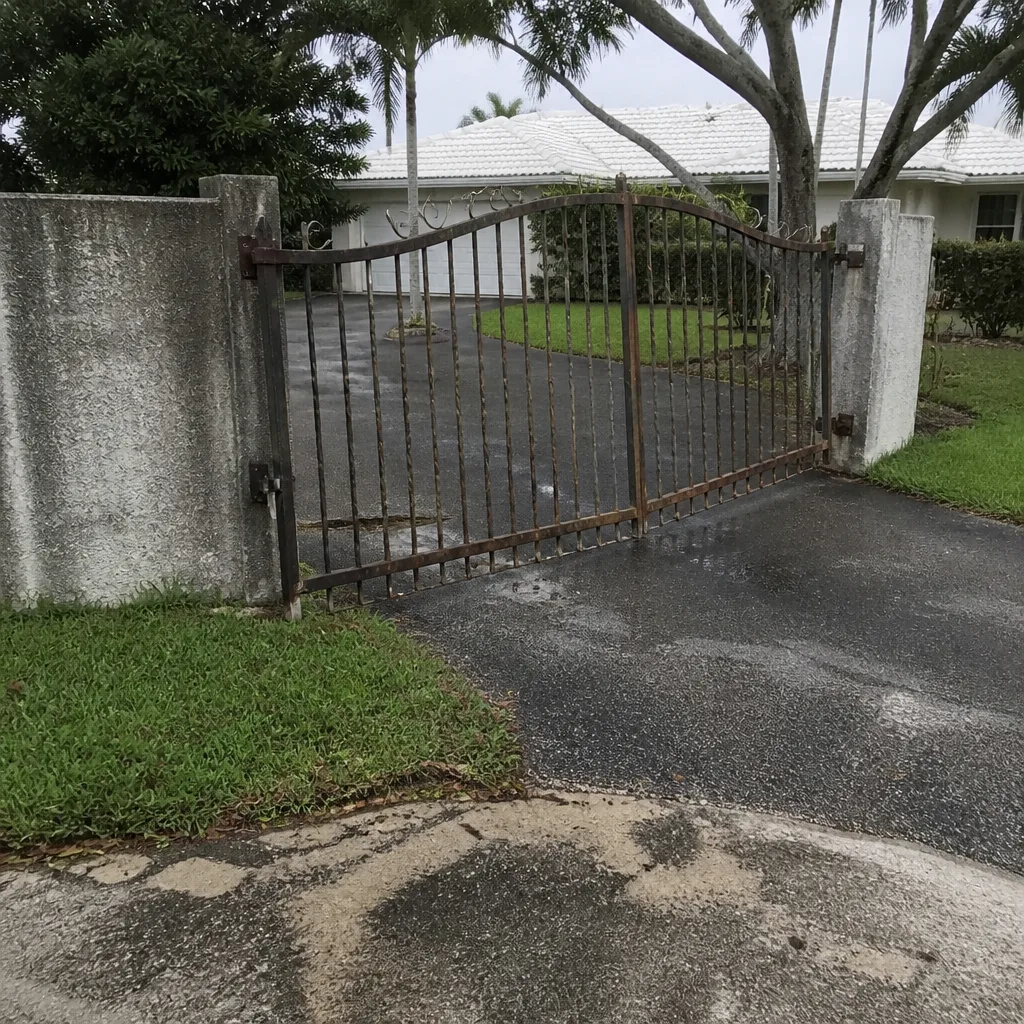 Before
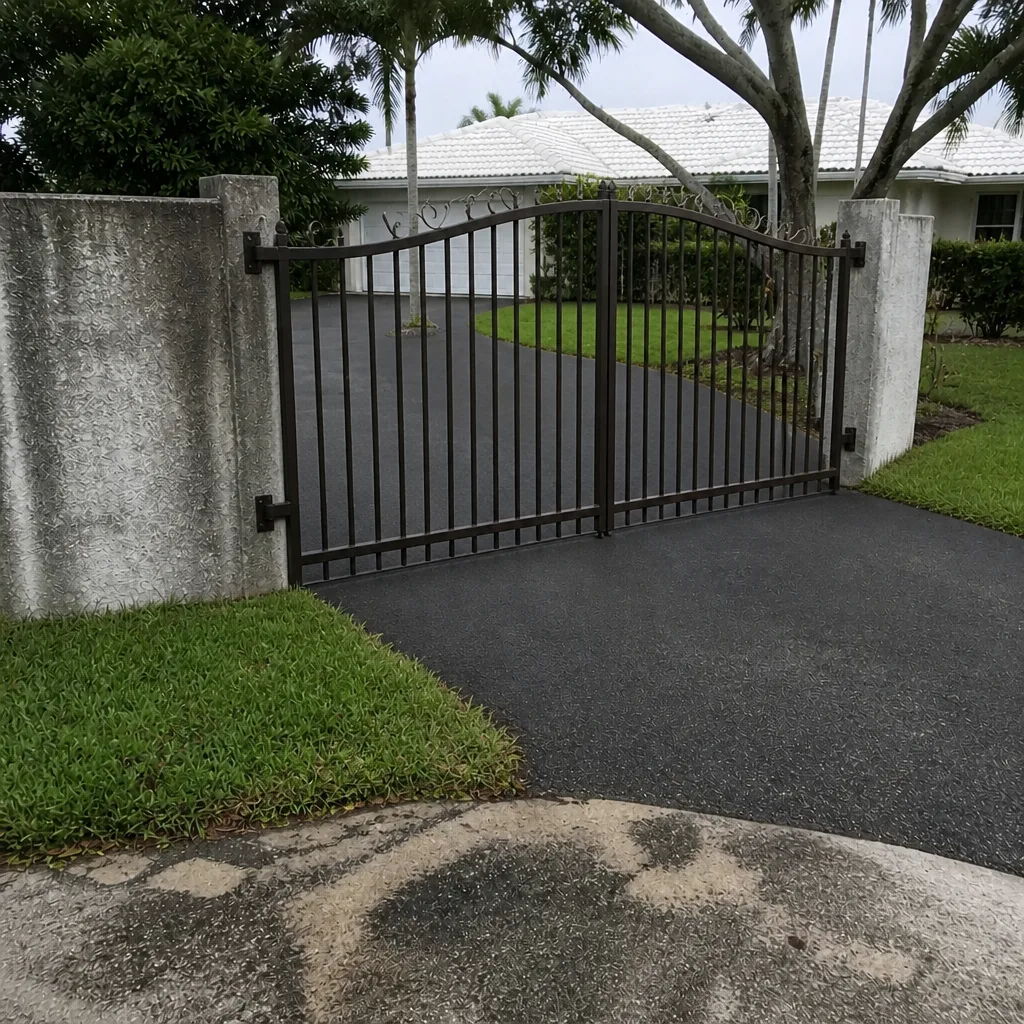 After
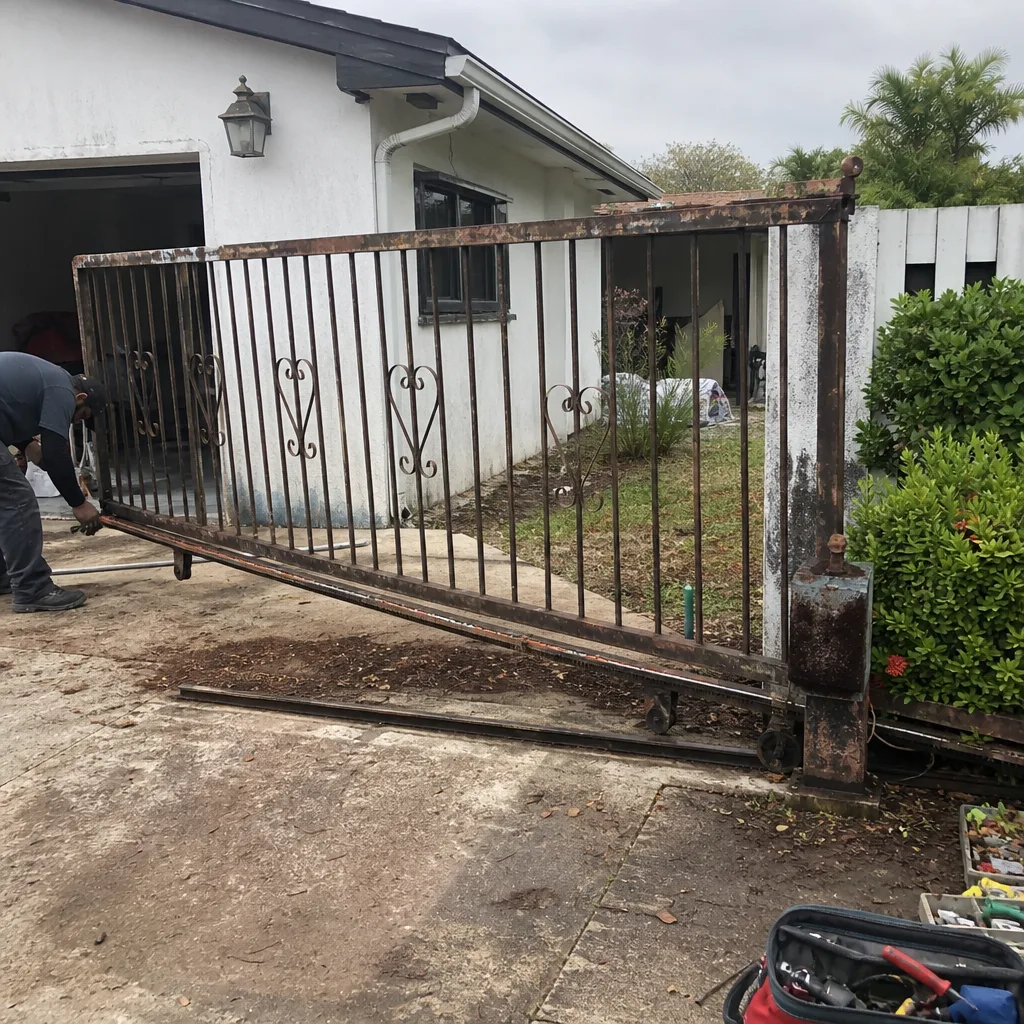 Before
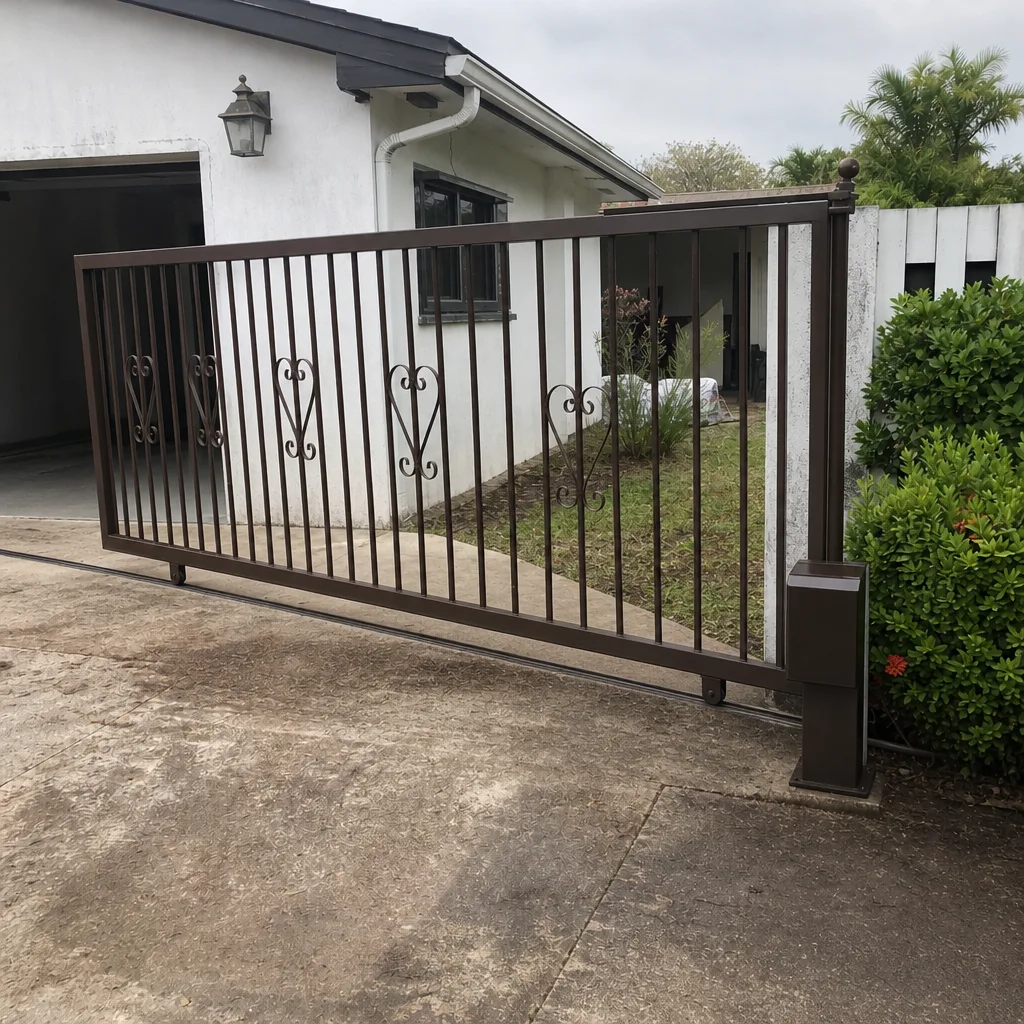 After
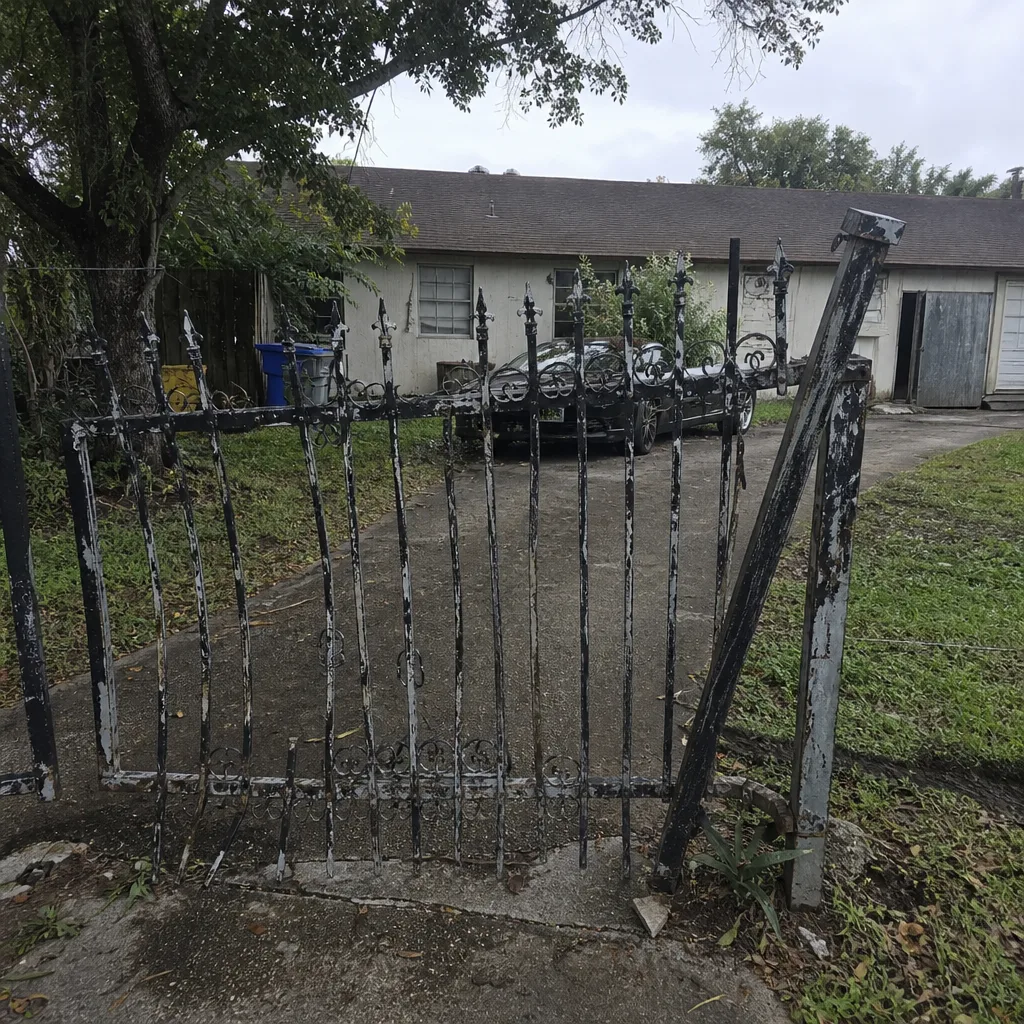 Before
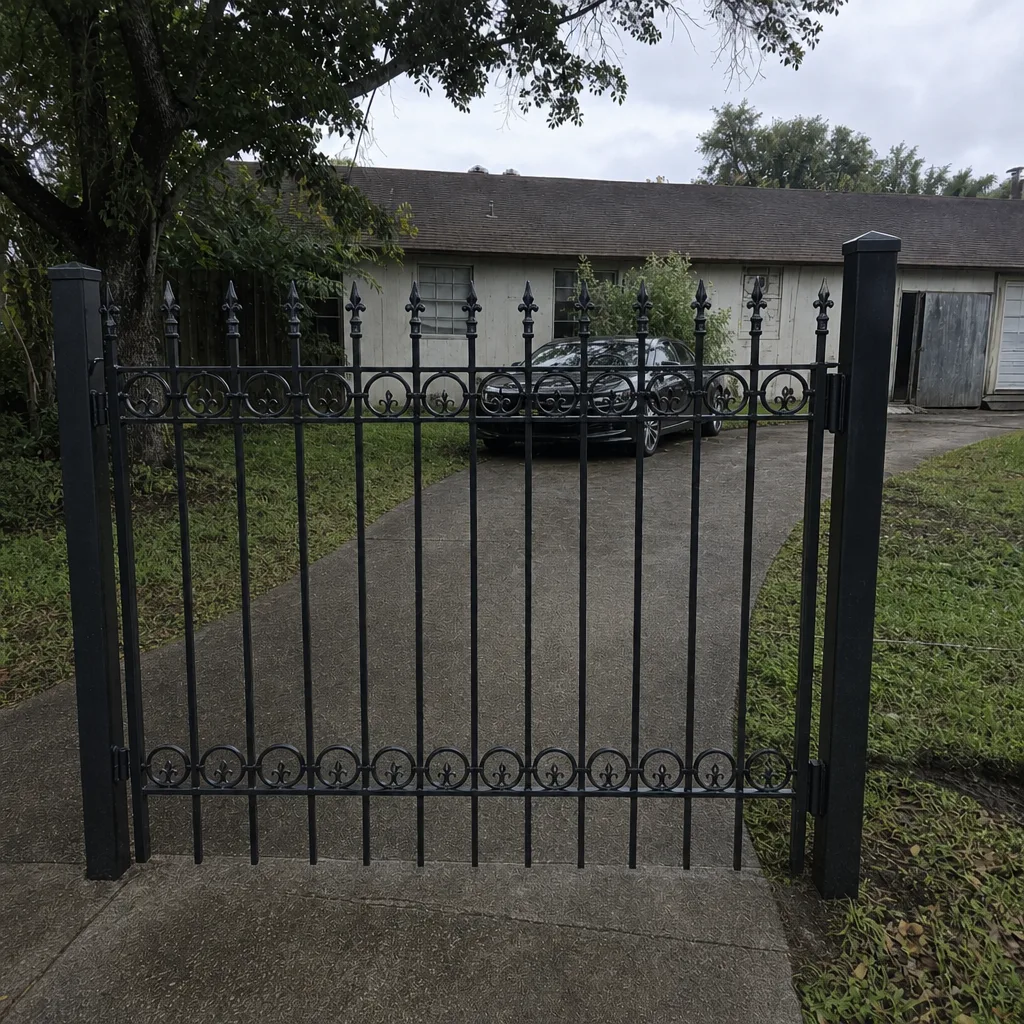 After
When to Call a Professional
Some gate problems are safe to diagnose and adjust. Others aren’t. Anything that involves opening an operator housing, metering a live circuit, or working on a heavy commercial slide gate belongs to a technician. A swing gate under tension, a slide gate that has come off its track, an operator that’s drawing current and won’t move – those carry real risk of crushing injury or electrical shock, and they’re not worth saving a service call for. A gate that cycles on its own, won’t close, or has stopped responding to its safety edges is a safety issue as much as a mechanical one, and it needs hands-on diagnosis.
If your gate is doing any of those things in Davie, we offer free estimates and upfront pricing. Call (877) 802-1841. We answer 24/7. Fast dispatch from 7am to 7pm, Sunday through Friday. The price is quoted and agreed before any work starts, and our technicians have up to 11 years of experience with the brands on your gate.
Frequently Asked Questions
Most gate repairs fall into a range driven by the part and the labor, and a technician who diagnoses the fault before quoting will always give you a firmer answer than a phone estimate. The written estimate sets the final price, and the price is agreed before any work begins. Call (877) 802-1841 for an exact quote – estimates are free.
Yes, same-day service is often available for gate repairs in Davie. We answer 24/7 and dispatch technicians fast from 7am to 7pm, Sunday through Friday. A call outside dispatch hours is booked into the next opening, Sunday through Friday, 7am to 7pm. Call (877) 802-1841 to check availability.
A gate that stops partway is usually hitting a torque limit, a mechanical bind, or a wiring short. Check whether it stops at the same physical point every time – that points to torque or a bind – or at random, which points to wiring. A technician with a meter can tell them apart quickly. Call (877) 802-1841 for a diagnosis.
In our experience, that’s almost always a safety sensor or loop detector issue. The gate is being told something is in the way, and it’s staying open for safety. Check the sensor alignment and look for anything that could read as a vehicle on the loop. If the problem started after rain, it’s likely a flooded loop splice. Call (877) 802-1841 if the sensor check doesn’t clear it.
We work on the gate you have, not a preferred brand. Our technicians have up to 11 years of experience and are trained on LiftMaster, FAAC, BFT, Linear, Viking, Ghost Controls, DoorKing, Elite, and Mighty Mule, covering both residential and commercial systems. We don’t push a brand; we diagnose the one on your gate. Call (877) 802-1841 to confirm yours.
You can safely check the breaker, the sensors, the track, and the manual release. Once the job involves opening the operator, metering a live circuit, or working on a heavy commercial slide gate, it belongs to a technician. The risk of injury on a heavy gate is real. Call (877) 802-1841 if you’re unsure where the line is.
The Bottom Line
Most gate failures in Davie start with three things: travel limits that have drifted, sensors and loops knocked out of alignment, and mechanical wear that binds the gate. The electronics are usually the last place to look, not the first. Run the force test, check the limits, confirm the loop before you blame the board, and always fix a mechanical bind rather than turning up the torque. Do the cheap checks first and you’ll avoid the expensive mistakes. If the diagnosis takes you into the operator housing or a live circuit, stop and call a technician. If you’d rather have a professional read it from the start, Davie residents can call (877) 802-1841 for a free estimate and upfront pricing. Visit Gate Repair Davie if you’d like to see the full scope of what we service. We work on the gate you have, and we’ll tell you honestly whether it needs a repair or a replacement.
Written by the team at Gate Repair Davie.